The Real Challenge with AI Tool Integration
Building AI systems that can act in the real world has always been more complicated than it first appears. Models are getting impressively capable at reasoning and planning, yet the moment you need them to interact with actual tools; databases, APIs, external services, or internal workflows; everything changes. Suddenly every integration risks becoming a security and compliance headache. Hard-coded tool lists quickly become brittle. Giving the model too much freedom feels reckless. Keeping it too constrained limits its usefulness.
For the past 6 months I have been working on a larger AI project code-named Deliberium. Along the way I have built several foundational subsystems. Nexara is the third of these that I have decided to open-source, and I chose to release it earlier because I believe the wider community; both in production environments and research; will find it genuinely useful right now.
Introducing Nexara
Nexara is a policy-bound capability runtime written in Rust. It acts as a clean, secure interface between AI intent and real-world execution. Rather than forcing every AI product team to reinvent secure tool discovery, policy enforcement, secret handling, and auditing from scratch, Nexara provides a modular, contract-driven layer that handles the hard parts while leaving identity, context, final execution, and deployment firmly in the hands of the host application.
In simple terms, the host product keeps control of what matters most to it. Nexara supplies the standardised contracts and runtime machinery for discovery, policy, secrets, remote tools, learning signals, and administrative operations.
How Nexara Works
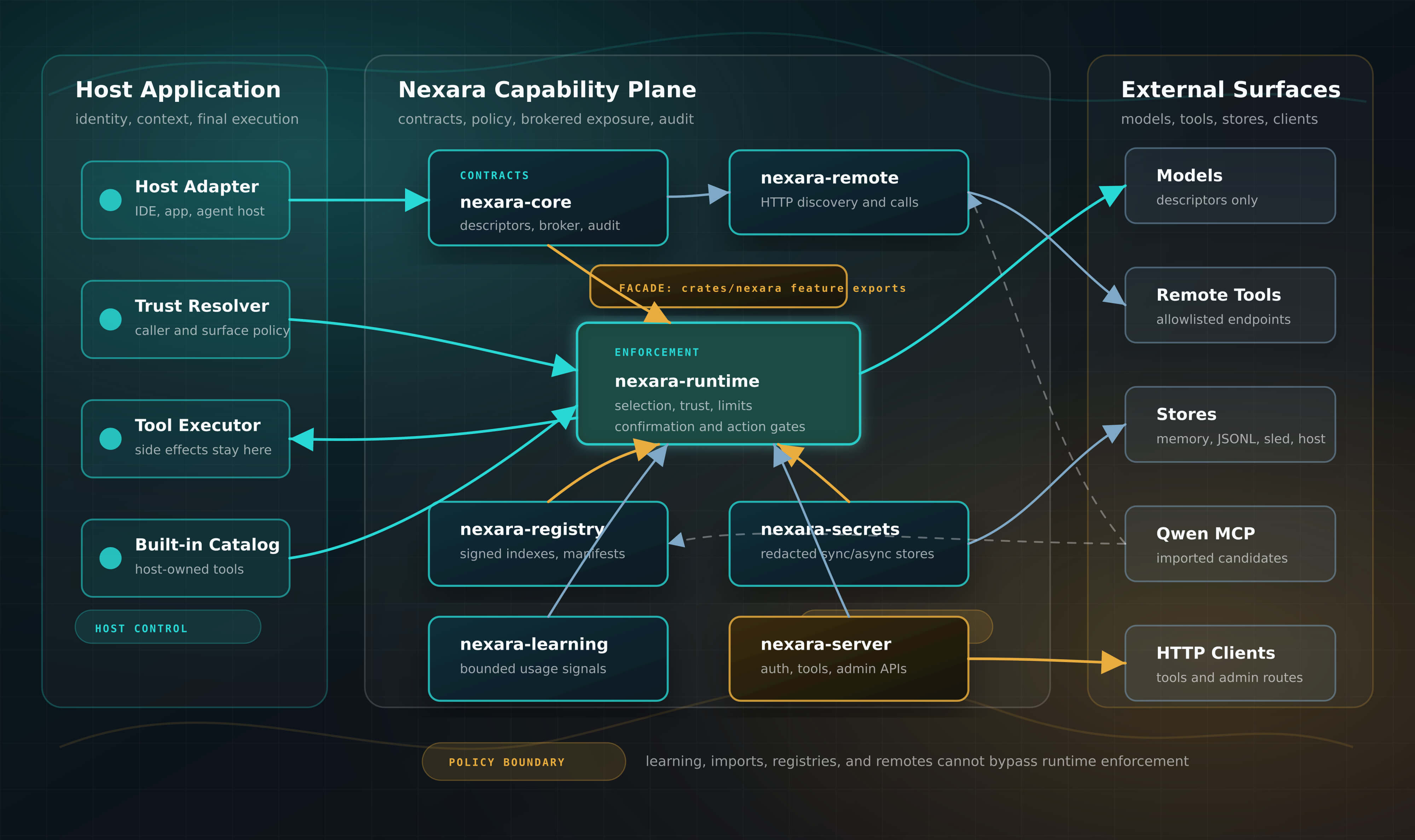
The architecture deliberately separates concerns. The host provides:
- Identity and user context
- Final tool execution
- Deployment environment and trust decisions
Nexara in turn owns:
- Tool and skill descriptors
- Signed skill registries
- Runtime policy enforcement
- Secret management (with redaction)
- Remote capability discovery and calling
- Structured audit records
- Optional learned usage ranking (which never overrides policy)
This separation means AI models never become the security boundary. Instead, hosts define policy once and Nexara enforces it consistently; whether tools are local, remote, or coming from signed third-party registries.
Core Features
Nexara ships with a focused but powerful set of capabilities:
- Signed Skill Registries - Publish and install verified capability packs containing trust tiers, action classes, secret requirements, confirmation policies, and host requirements. The host decides what to trust and install.
- Policy-Bound Execution - Every tool call is checked against scope, payload size, action class, trust profile, confirmation state, and concurrency limits before it ever reaches the executor.
- Remote Tool Contracts - Discover and call remote Nexara endpoints over HTTP with built-in auth providers, allowlists, route learning, diagnostics, and circuit-breaker behaviour.
- Secrets and Redaction - First-class support for sync and async secret stores with automatic redaction in audit logs.
- Audit Trails and Learning Signals - Structured, reliable audit records plus optional usage signals that can improve tool ranking over time without compromising policy.
- Multiple Integration Paths - Full Rust crate with modular features, an authenticated HTTP server, and a typed JavaScript client for browser or Node environments.
- Compatibility Layer - Initial support for importing Qwen-family configurations.
All of this is designed to feel natural in a Rust codebase while remaining lightweight and composable.
Getting Started
Installation and quick-start guides are available on the project website at https://nexara.deliberium.ai/. The GitHub repository contains detailed documentation, examples, and the full set of crates.
You can begin by embedding the runtime directly in your Rust application or by running the standalone server and connecting via the JavaScript SDK. Whichever path you choose, the contracts remain consistent.
The repository is here: https://github.com/deliberium/nexara
Why Open Source Nexara Now
I originally built Nexara as an internal component for the broader Deliberium project. The more I worked with it, the clearer it became that many teams building agentic AI products face the same recurring challenges around safe tool use. Releasing it as open-source MIT software allows the community to benefit immediately and, I hope, to contribute improvements that will strengthen the entire ecosystem.
Contributions are warmly welcomed; whether through code, documentation, new storage backends, additional compatibility layers, or simply thoughtful issues and discussions.
Looking Ahead
Nexara is still at version 0.1.0, but the foundation is solid: twelve Rust crates, four storage modes, and production-ready server APIs. The road map includes broader language support, richer learning engines, and expanded registry tooling.
The goal is simple: make it dramatically easier for AI products to use powerful, real-world capabilities while keeping security, policy, and operational visibility where they belong; under the control of the team that ships the product.
As Alan Kay once observed, The best way to predict the future is to invent it. With Nexara I am trying to invent a future in which powerful AI agents can safely reach into the real world without forcing every team to become security experts first.
I invite you to explore the project, try it in your own work, and let me know what you think. Whether you are building production AI systems or conducting research into agentic architectures, your feedback and contributions will help shape what comes next.
Try Nexara today : https://nexara.deliberium.ai
GitHub -> https://github.com/deliberium/nexara