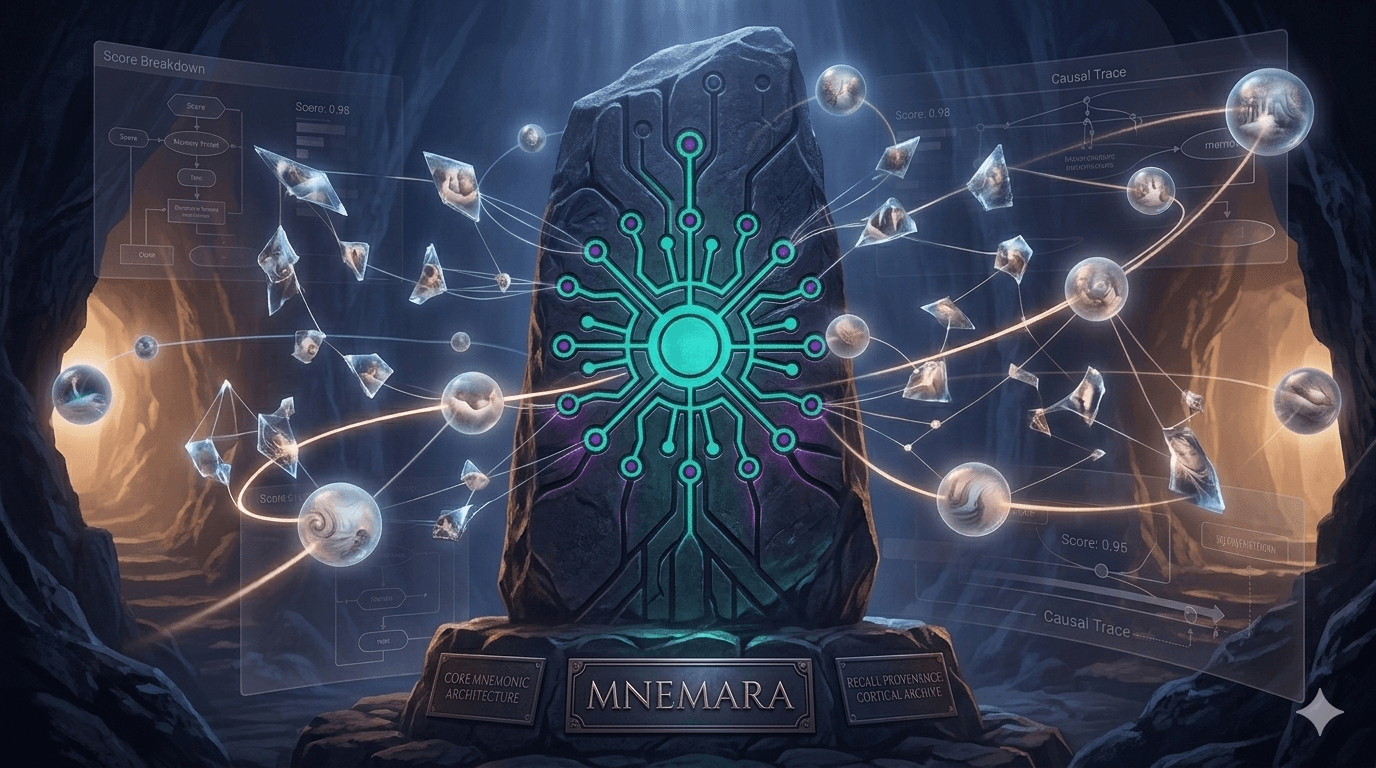
In the midst of a larger AI project I have been tinkering with, one challenge kept surfacing: intelligence without reliable memory is little more than clever improvisation. So I built Mnemara, a local-first, explainable episodic memory engine. I decided to open-source it early, believing the wider community of developers, researchers, and AI builders would find it valuable for production systems or experimental work alike.
Why Memory Is the Foundation of Real Intelligence
Intelligence does not float in a vacuum. It needs a place to live, to accumulate experience, and to draw on the past when shaping the future. As the Roman philosopher Cicero observed, “memory is the treasury and guardian of all things”. In artificial systems, this truth is even more pronounced. Large language models excel at pattern matching within a fixed context window, yet they forget the moment that window closes. Agents tasked with long-running workflows, open-ended research, or multi-step planning quickly lose continuity.
Without structured memory, AI agents repeat mistakes, overlook unresolved threads, and struggle to maintain causal awareness. Mnemara was created to solve exactly that problem, providing a durable, auditable home for episodic knowledge that grows with the agent rather than evaporating between prompts.
What Mnemara Actually Is
Mnemara is an open-source (MIT-licensed) memory engine written in Rust. It is deliberately local-first, meaning it runs embedded in your application or as a lightweight daemon with zero external cloud dependencies. At its heart lies a product-neutral domain model for episodic memory: every record carries not just content, but rich contextual metadata that lets the system reason about continuity, importance, and relationships.
Think of it as an internal diary for your AI agent, complete with timestamps, emotional valence signals, open loops, and causal threads linking one event to another.
How It Works Under the Hood
The engine is organised as a modular Rust workspace with clean separation of concerns. The core crate defines memory records, scopes, and recall semantics. Storage back-ends (currently sled for embedded speed and a file-based option for portability) handle durable persistence with batch upserts, compaction, snapshots, and lineage-preserving supersession. A gRPC daemon built on Tonic adds service-mode deployment with TLS, mTLS, and HTTP/JSON admin endpoints for broader integration.
When an agent stores a memory, it supplies an episode context that includes:
- Continuity state (open or closed)
- Salience signals such as reuse count, novelty score, goal relevance, and unresolved weight
- Causal record IDs linking related events
- Optional affective or recurrence cues
Recall is where the magic happens. Every query returns not only results but a complete explanation: per-hit score breakdowns (lexical, temporal, metadata, episodic, salience, policy), the chosen scorer profile, planner stages, candidate sources, filter reasons, and correlation IDs. You can see exactly why a particular memory surfaced and debug or refine the retrieval logic with full transparency.
This explainability is deliberate. In production environments, trust is non-negotiable; Mnemara lets you audit, trace, and improve rather than treat memory as a black box.
Features That Deliver Real Depth
Several capabilities set Mnemara apart from simpler vector stores or key-value caches:
- Episodic continuity and salience: Memories are not isolated facts; they form living timelines with open loops and causal chains.
- Fully explainable recall: Score breakdowns and planner traces turn retrieval into an observable process.
- Dual deployment: Embed it for zero-latency in-process use, or run the daemon for multi-language access via the official JavaScript SDK.
- Durable and portable storage: Snapshots, export/import packages, integrity checks, and repair workflows ensure your memory survives restarts, migrations, or hardware changes.
- Security and observability: Bearer-token authentication with role-based permissions, request metrics, and bounded admission control keep everything production-ready.
These are not afterthoughts. They emerged from the practical demands of building agents that must operate reliably over weeks or months.
Getting Started Is Straightforward
Installation guidance lives on the project website at https://mnemara.deliberium.ai/. For Rust users, simply add the facade crate with the sled feature:
cargo add mnemara --features sledThe repository contains detailed documentation, usage examples, architecture notes, and a full user guide. Whether you embed it directly or spin up the daemon, you can have a working memory store in minutes. I encourage you to try it; your feedback will sharpen the roadmap.
Why Open Source Matters Here
I could have kept Mnemara internal to my broader project. Instead, I chose to release it now because robust memory infrastructure should not be a competitive secret. It belongs to the community of builders who are pushing AI beyond one-shot conversations toward persistent, trustworthy agents. Contributions are warmly welcome; the roadmap, contributor guidelines, and issue tracker are all public. If you see an opportunity to extend scorers, add new back-ends, or improve the JavaScript SDK, the door is open.
Looking Forward
Mnemara is still young, yet it already demonstrates that memory for AI need not be an opaque embedding store or a fragile prompt cache. It can be structured, explainable, and portable, giving agents the same continuity that biological intelligence takes for granted.
The larger project I am working on continues to evolve, but Mnemara has already become its most reusable piece. If you are building agents that must remember, reason over time, and earn trust, I invite you to explore it, experiment with it, and help shape what comes next.
True intelligence is not merely fast thinking; it is thinking that can stand on the shoulders of everything it has ever known. Mnemara aims to make that possible.