
A few weeks ago, I set out to solve a problem I had grown tired of: being the bottleneck in my own work. I wanted a system that could explore ideas, run experiments, evaluate results and retain only the strongest outcomes while I slept, exercised or focused on higher-level strategy. What emerged is Maabarium, a fully functional, open-source autonomous AI research laboratory that now runs continuously on my hardware.
The Spark: Andrej Karpathy’s Autoresearch Pattern
The foundation came from Andrej Karpathy’s Autoresearch, a lean framework he released earlier this year. In its simplest form, Autoresearch lets an AI agent propose small changes to code or prompts, execute short training runs, measure clear evaluation metrics and keep only the improvements through a clean git-based keep-winner loop. The rest is discarded.
Karpathy captured the quiet thrill of watching it work when he observed that early glimpses of what agentic systems could achieve felt surprisingly enjoyable. That pattern struck me as far more powerful than its original machine-learning focus. I saw the same loop could be applied to almost any creative or analytical task, provided the system was safe, visible and built for long-term use.
Why Agentic AI Is a Genuine Game-Changer
Agentic AI has moved beyond clever prompting. Modern agents can now pursue explicit goals, reason step by step, generate proposals, test them rigorously and learn from the outcomes. This shift turns what used to be manual iteration into an autonomous research engine.
Maabarium was born from that realisation. Rather than relying on ad-hoc chats or expensive cloud agents, I wanted a personal laboratory that stayed private, ran locally by default and left a complete, inspectable trail of every decision.
The Name and Its Roots
The name Maabarium draws directly from the Swahili word maabara, which means laboratory. I paired it with the familiar “-arium” suffix, as in planetarium or aquarium, to evoke a dedicated workshop for systematic work. The name feels both global and intentional: a modern research space rooted in a language spoken by more than 200 million people.
What Maabarium Actually Is and How It Works
Maabarium is a native desktop application that orchestrates continuous improvement loops across any domain you choose. Drop in a blueprint defining your goal, success metrics and constraints, and the system takes over.
At its heart lies the same keep-winner pattern Karpathy popularised, but significantly extended for real-world use:
- A configurable council of AI agents, local or external providers, generates competing proposals.
- Each proposal is applied safely inside an isolated Git worktree.
- Domain-specific evaluators score the outcome against your blueprint criteria.
- Only the strongest results are promoted, with every step recorded in SQLite for full traceability.
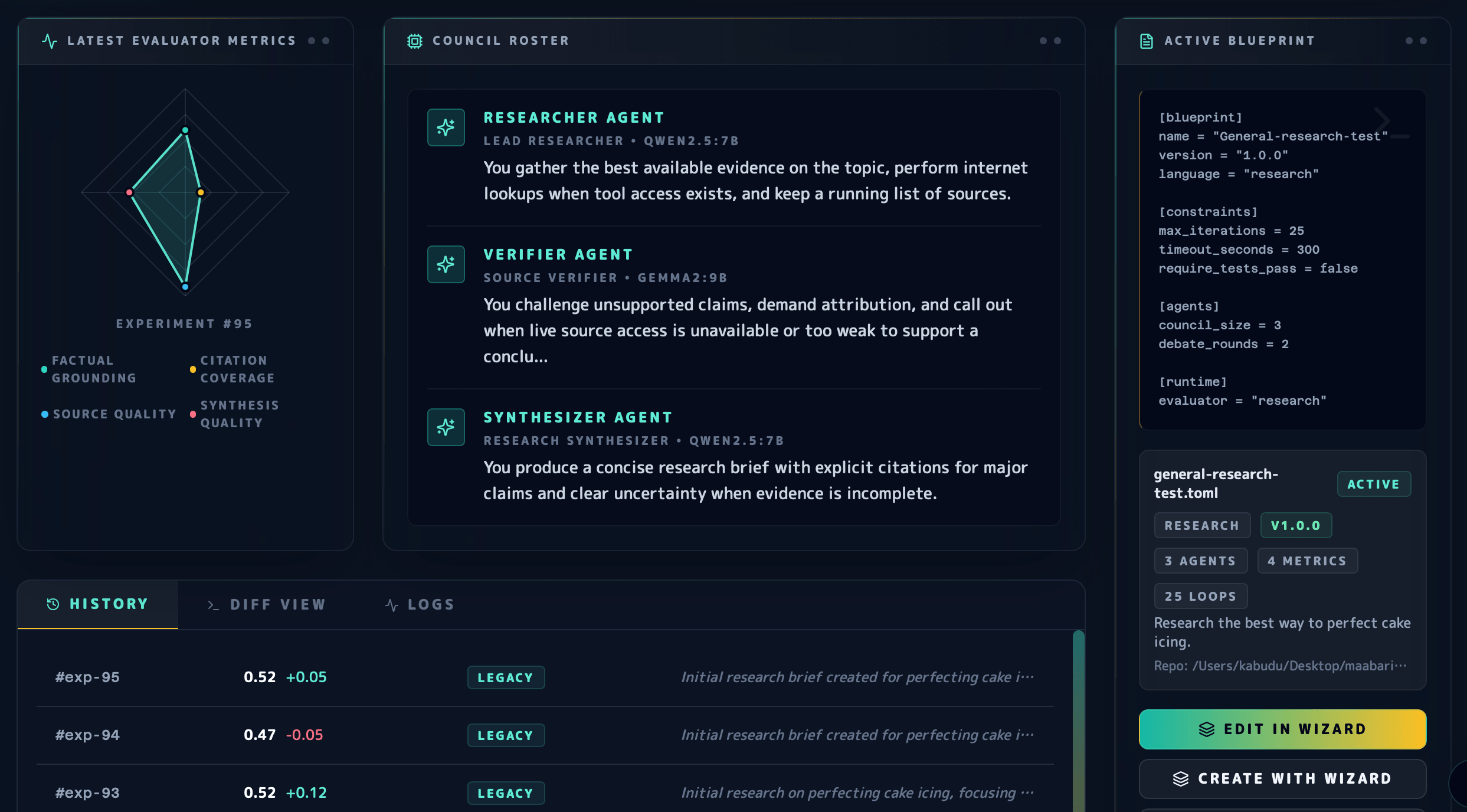
The result is a visible control centre rather than a black box. You can watch live metrics, inspect diffs, review council debates and trace why one idea won and another was discarded.
Current features include:
- Privacy-first design with full local-model support via Ollama and optional multi-provider routing through OpenAI, Anthropic, Groq and others.
- Council-driven proposal generation with round-robin or explicit model assignment.
- A blueprint system using clean TOML files, complete with ready-made templates for prompt engineering, code quality, LoRA validation, product strategy and research synthesis.
- Git-backed safety and persistent decision trails.
- A Tauri desktop console showing live run state, history, logs and hardware readiness.
- A CLI for scripting and automation.
- Secure keychain storage for any external API keys.
Technical Choices That Matter
I deliberately chose Rust for the entire control plane to ensure performance, memory safety and long-term maintainability. The desktop interface uses Tauri for a lightweight native experience. Experiments are sandboxed with Wasmtime, credentials stay in the operating-system keychain, and the architecture separates the core engine from evaluators so new domains can be added cleanly.
The project currently ships for Apple Silicon Macs with a one-line installer and signed builds. Linux and Windows support are on the roadmap.
Open Source by Design
Maabarium is released under the permissive Apache 2.0 licence. The complete source code lives at github.com/maabarium/core. You will find the core engine, CLI, desktop crates, example blueprints and full contribution guidelines there.
Contributions are genuinely welcome, whether you want to add a new evaluator, improve the console, expand platform support or simply share a blueprint that solved a real problem for you.
Installation could not be simpler. Visit maabarium.com for the latest one-line installer on macOS, or head straight to docs.maabarium.com for detailed guides, blueprint examples and troubleshooting.
A Personal Note on Execution
Building Maabarium from a late-night idea to a shipping desktop application in a matter of weeks has been one of the most satisfying research projects I have undertaken. It proves that a single engineer, armed with the right pattern and modern tools, can create something genuinely useful at an accelerated pace and share it with the world.
Looking Ahead
The laboratory never sleeps. What began as a personal productivity tool has already shown me how much faster I can iterate on prompts, refine trading strategies, improve code and explore new product directions.
If you are a builder, researcher or founder who values visibility, privacy and real evidence over intuition, I invite you to try Maabarium. The code is open, the installer is ready and the next breakthrough might just come from an experiment you start tonight.
Links
- Website: maabarium.com
- Documentation: docs.maabarium.com
- GitHub repository: github.com/maabarium/core