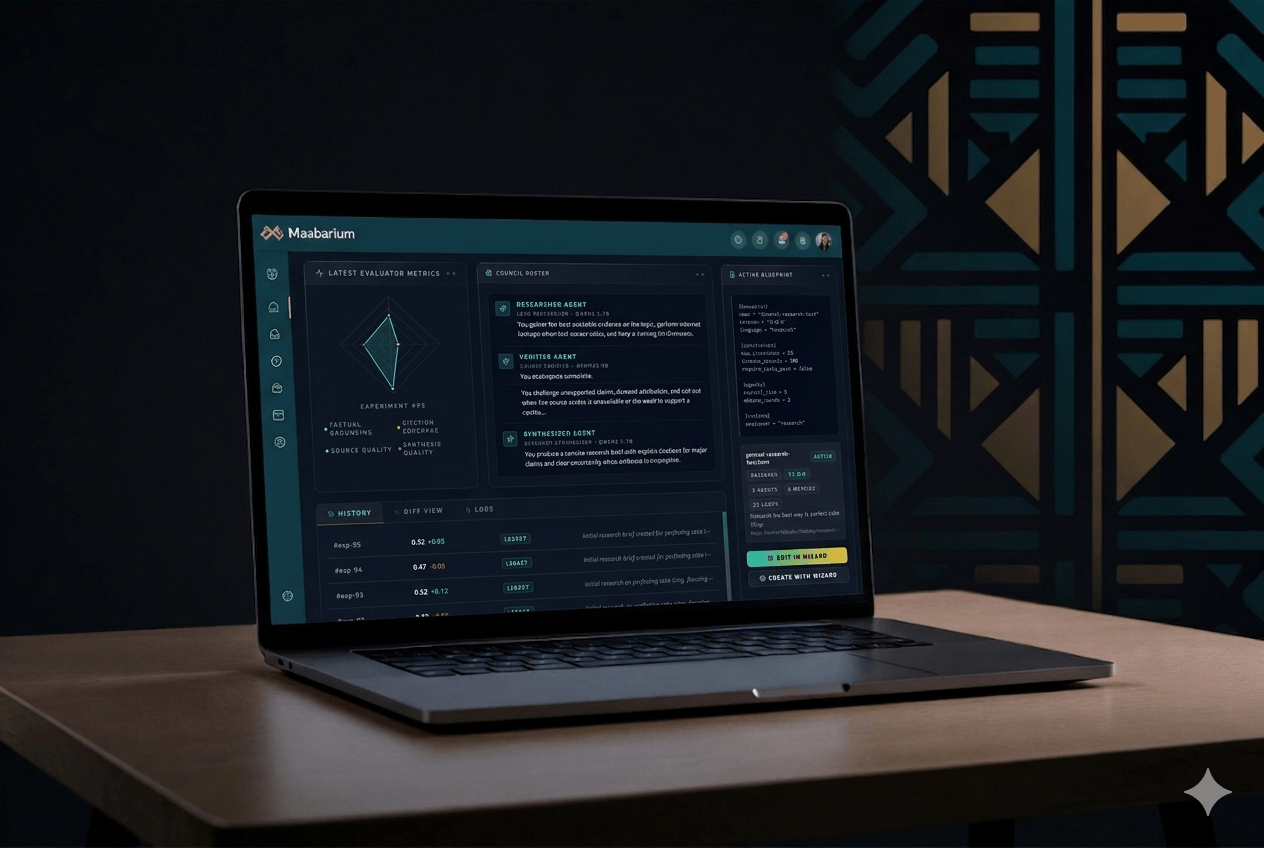
In the opening chapter of this series we sketched the blueprint for Maabarium: an open-source autonomous laboratory that runs on local hardware, proposes its own experiments, executes them in isolated sandboxes, evaluates the outcomes, and keeps only what works. The vision was clear. The reality, as anyone who has tried to run early prototypes will attest, was still a little rough around the edges.
Today we ship v0.4.1 of the Desktop application. Far from a flashy list of headline features, this release is the quiet, meticulous work of tightening every bolt so that the laboratory can truly run without constant human intervention. It is the difference between a promising idea and a system that simply gets on with the job.
The Guided Setup Revolution
The single biggest barrier to entry has always been the first thirty minutes. Installing dependencies, choosing providers, wrestling with model names, and praying the workspace would initialise without drama. v0.4.1 replaces that ordeal with a guided setup that now ships as a complete readiness feature set.
A shared scanner checks hardware, detects the workspace, validates supported providers, and offers one-click fixes for local dependencies. Recommended profiles appear automatically. Remote model suggestions are informed by what you actually have access to, and the searchable picker lets you select and persist custom OpenAI-compatible, Anthropic, or Gemini endpoints without guesswork.
The result is not merely faster onboarding. It is reliable onboarding. New contributors can move from download to first autonomous research run in minutes rather than hours, freeing the laboratory to focus on science rather than scaffolding.
Smarter Research That Knows When to Pause
Autonomy is only useful if it is also efficient. Earlier versions occasionally fell into the trap of polite persistence: the council of agents would rephrase a dead-end query, chase another tangential source, and quietly burn through iteration budgets without admitting defeat.
v0.4.1 introduces early termination for consecutive evidence-gap no-op proposals. The system now recognises when further proposals are simply dressing up the same missing information and stops gracefully. Research discovery defaults sensibly to DuckDuckGo scraping for most users, with Brave API available only in Advanced mode. HTTP-backed providers benefit from bounded timeouts and intelligent retries on transient failures.
The laboratory, in other words, has learned the difference between diligent inquiry and fruitless circling. It wastes less time and therefore delivers more meaningful results per cycle.
Stability Beneath the Surface
The most satisfying improvements are often the ones users never notice. Wasmtime is now pinned to a patched 43.0.1 release, clearing long-standing security advisories. Logging distinguishes intentional cancellations from genuine failures. The workspace widget no longer wastes cycles re-analysing on every render. Remote provider validation is more forgiving of slower endpoints yet more thorough in confirming model availability.
These changes may seem incremental, yet together they remove the small frictions that previously required manual oversight. The system can now run for hours or days with far less babysitting.
Why These Refinements Matter for True Autonomy
Thomas Edison once observed that genius is one per cent inspiration and ninety-nine per cent perspiration. Maabarium’s keep-winner loop has always aimed to automate the perspiration. With v0.4.1 the perspiration becomes invisible. The laboratory can propose, test, evaluate, and iterate while its human stewards sleep, work elsewhere, or simply think about the next big question.
By making setup frictionless and research loops self-correcting, we move closer to the original promise: an AI research environment that never sleeps because it no longer needs constant waking.
Looking Forward
This release is not the destination. It is the moment the prototype becomes a platform. The foundations are now solid enough that future chapters can focus on richer agentic behaviours, deeper evaluation frameworks, and broader domains of inquiry.
If you have been following the series, now is the ideal time to try the Desktop application. The repository remains fully open under Apache 2.0. The code is yours to inspect, run, and improve.
The laboratory is awake. It is better prepared than ever to stay that way.