It is easy to imagine tomorrow’s technology. The harder question is what we are doing today to make it possible.
I think we are living through a technological inflexion point. Advances in computing, artificial intelligence and engineering increasingly feed into one another, accelerating what we can explore. Problems that once felt far beyond an individual’s reach are becoming approachable in ways they were not before.
But tomorrow’s technology will still depend on today’s research. Someone has to ask the question, work through the mathematics, build the model and find out whether the idea survives contact with evidence.
I wanted somewhere to do that work openly.
That space is Tomorrow, Tested.
The barrier to starting has changed
Research has traditionally demanded a substantial investment before you could even begin: specialist knowledge, familiarity with the literature, programming skills and enough experience to recognise which questions were worth pursuing.
Those things still matter. AI has not made expertise unnecessary, and a convincing explanation is not the same as a correct one. What it has changed is the distance between curiosity and a meaningful first investigation.
I can ask for help understanding unfamiliar mathematics, follow references into a new field, develop a computational model and examine competing explanations. When something fails, I have another way to investigate why.
That is a remarkable change for someone who explores research as a hobby.
It does not mean anyone with an AI assistant has become a physicist. It means more people can begin learning seriously, formulate questions and contribute work that others can inspect. Expertise can develop through the investigation, rather than always being the price of admission.
The opportunity is not simply to produce more ideas. We already have plenty of those. It is to turn more ideas into questions that can actually be tested.
A home for the threads that do not become products
My curiosity rarely stays within one subject.
I explore different research threads, sometimes following a practical problem and sometimes pursuing an idea because I want to understand whether it could work. Some develop into products. Others lead to a useful calculation, an unexpected limitation or a conclusion that the original approach does not hold up.
I wanted a space for all of that, not just the projects that acquired a polished interface and a launch announcement.
There is knowledge in an unsuccessful approach. There is value in discovering that a measurement was being interpreted incorrectly. A carefully documented limitation can save someone else from repeating the same mistake.
Tomorrow, Tested is intended to make those contributions visible.
Its website is a Research Atlas: a place to understand what each investigation is asking, see the results and follow them back to the underlying evidence. The explanation should be accessible without requiring the reader to become an expert first. The detailed records should still be available for anyone who wants to challenge the conclusion.
The first two research areas give a sense of the range I want that space to accommodate.
First, can we trust the motion we are measuring?
The first investigation starts with a deliberately contained problem: a simulated spacecraft rotating around a single axis.
Imagine turning a spacecraft to face a particular direction. Its controller needs to manage how quickly it rotates, how accurately it points and whether it remains within its operating limits. Before trusting the controller, we also need to trust the way we describe and measure that motion.
CP-001 compares retained simulated motion with an independent replay using the same inputs. It then examines seven registered scenarios against limits covering timing, pointing, rotation rate, wheel momentum and evidence requirements.
“Single-axis” keeps the problem manageable. “Measurement audit” describes the comparison. “Corrected” matters because the current revision fixes an earlier measurement interpretation while retaining the previous evidence.
This is not a physical spacecraft test, and agreement between two implementations does not establish flight readiness. It helps answer a more immediate question: does the published result reliably follow from the model and inputs we said we were testing?
The current result is rejected because some registered requirements have reproducible counterexamples.
That result belongs in the Atlas just as much as an acceptance would. The point was to discover what the system does, including where it crosses a boundary.
Then, could we build Pathfinder?
The second research area begins somewhere much more ambitious.
Quaternion Pathfinder is a conceptual interstellar spacecraft, built around a proposed propulsion idea I have called the Quaternion Field Radiation Engine. The original vision imagines travel at 2c: twice the speed of light.
That is the speculative ambition, not an established theoretical top speed. Under special relativity, an object with mass cannot be accelerated to light speed through ordinary local motion, let alone beyond it. Any proposal departing from that framework would need a physically specified mechanism and extraordinary evidence. NASA’s explanation of relativistic speed limits provides useful background.
I want to explore that ambition without allowing the image of a spacecraft to stand in for proof that its engine works.
The Pathfinder research programme therefore breaks the dream into questions we can investigate.
The first is much smaller than interstellar travel: can changing the relative timing of two emitters steer their recoil in a mathematical model, while properly accounting for energy and momentum?
Radiation carries momentum. Sending it in one direction produces a reaction in the other. The challenge is to account for the entire exchange, rather than mistaking an incomplete calculation or numerical artefact for a new propulsion effect.
PF-001 now has a retained ten-case result that passes its eleven registered obligations within a simplified scalar-field model. That is a mathematical milestone. It does not demonstrate a working engine, useful spacecraft thrust or faster-than-light travel.
The next challenge is to connect that model to physically specified electromagnetic sources and drivers, then develop measurements capable of distinguishing a real effect from conventional recoil, heat, vibration and error.
The separate modified-inertia proposal also needs its own mechanism and evidence. A successful radiation-recoil calculation cannot validate it by association.
Quaternions provide a powerful mathematical language for orientation. Their presence in a model does not, by itself, create a new force.
The spacecraft makes the ambition visible
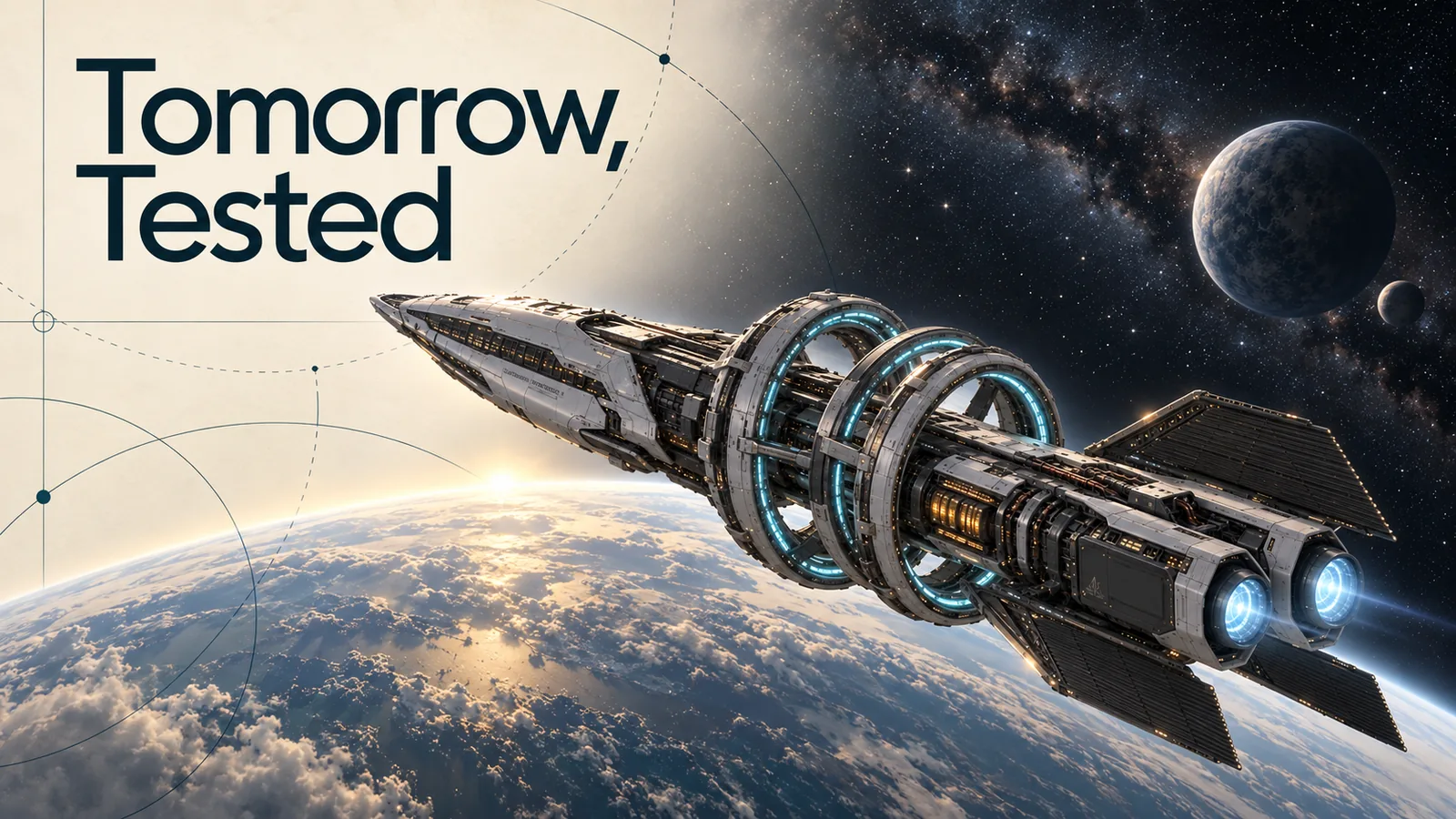
The Pathfinder concept artwork and departure film have a different job from the experiment records.
They show what I am working towards: a spacecraft whose rings illuminate, whose emitters come alive and which departs into open space. They make the programme’s ambition tangible.
They are artistic visualisations, not simulations of demonstrated propulsion.
I think there is room for both the cinematic vision and the exacting research. The vision gives the work direction. The experiments determine which parts of that vision can survive.
If the evidence forces the design to change, the design should change. If a proposed mechanism fails, that finding should remain visible.
Curiosity is the beginning, not the verdict
My hope is that Tomorrow, Tested becomes a useful contribution to the shared pool of knowledge from which future technology emerges.
Not every investigation will produce a product. Not every promising model will describe something nature allows us to build. But work that makes a question clearer, exposes a mistake or establishes a reproducible result can still move us forward.
AI has made it easier for me to enter unfamiliar territory. The responsibility is to investigate it carefully and share what I actually find.
That is the purpose of Tomorrow, Tested: somewhere to pursue ambitious questions, make the work understandable and let the evidence decide what comes next.