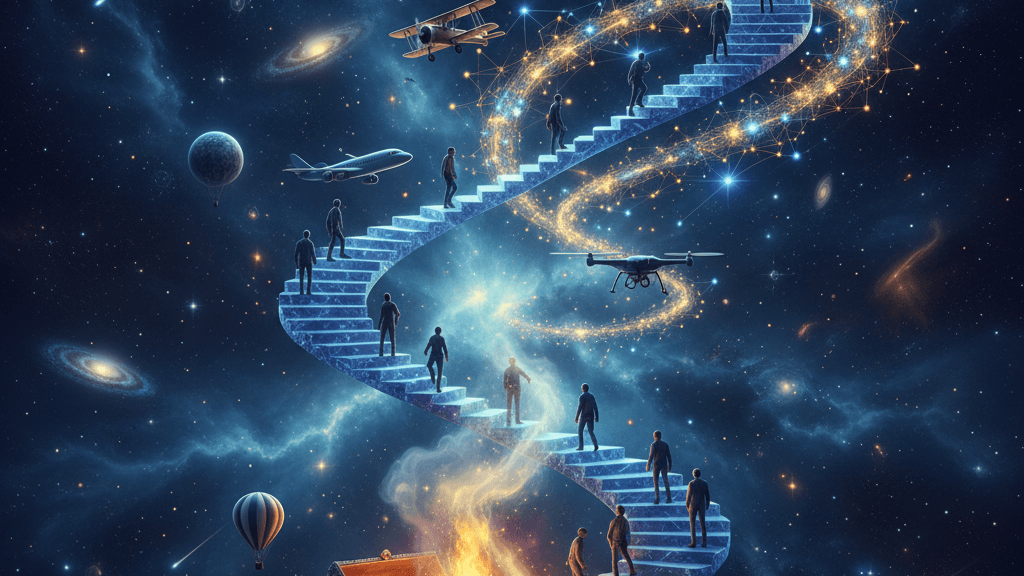
The Eternal Flame of Curiosity
From the moment our ancestors first struck flint to create fire in dimly lit caves, humanity has been propelled by an insatiable curiosity. This primal drive to question, explore, and master the unknown has carried us across continents, through ice ages, and into the gleaming megatropolises we inhabit today. Curiosity is not a passing phase; it is woven into our nature. As Albert Einstein once observed, “The important thing is not to stop questioning. Curiosity has its own reason for existing.” It drove the invention of the wheel, the printing press, and the steam engine. Each leap forward only sharpened our appetite for what lies beyond. In the Stone Age, we wondered how to hunt more efficiently; today, we ponder the nature of consciousness and the fabric of spacetime. As long as humans remain curious, the pursuit of new knowledge, and the technologies it births, will endure.
The Pandora’s Box of Discovery
Technology resembles Pandora’s box in the most profound sense: once opened, its contents spill forth in ways we can scarcely predict. One breakthrough invariably unlocks others, creating a never-ending spiral of innovation. Consider the history of human flight. Ancient myths spoke of winged gods and daring leaps from towers. In the late 18th century, fragile hot-air balloons carried dreamers aloft for the first time. Then, in 1903, the Wright brothers achieved powered, controlled flight with their fragile biplane. Within decades, we witnessed jet-powered supersonic travel, colossal commercial airliners crisscrossing the globe, and now advanced systems built with lightweight composites, fly-by-wire controls, efficient turbofan engines, ubiquitous drones, and emerging electric and hybrid aircraft striving for sustainable skies.
Each stage built upon the last, revealing unforeseen possibilities. The same pattern repeats across domains: the transistor begat the microchip, which enabled personal computing, which fuelled the internet, which now powers artificial intelligence. Discoveries do not halt; they accelerate, revealing ever more layers of the unknown.
Artificial Intelligence: The Great Accelerator
We stand at the threshold of perhaps the most transformative chapter yet. Artificial intelligence, advancing towards artificial general intelligence (AGI) and potentially artificial superintelligence (ASI), promises to compress centuries of human evolution into mere decades. For the moment, AI serves as a vast repository of accumulated human knowledge; a multi-dimensional, searchable database that uncovers novel correlations and insights at unprecedented speed.
Soon, however, it will venture far beyond our current understanding. AI systems may uncover new principles in physics, chemistry, and biology, reshaping our comprehension of the universe itself. Imagine breakthroughs in quantum materials, synthetic biology, or cosmology that elude even the brightest human minds working alone. Yet even when AI illuminates vast swathes of the unknown, our curiosity will persist. We will ask what lies beyond AI-generated knowledge: the limits of computation, the nature of consciousness in machines, or realms that require a synthesis of human intuition and silicon precision.
As Richard Feynman put it, “Study hard what interests you the most in the most undisciplined, irreverent and original manner possible.”
Acknowledging the Shadows: Are There Truly No Limits?
To claim technology knows no bounds is not to ignore reality. Critics rightly point to potential ceilings. The laws of physics impose hard constraints; nothing can exceed the speed of light, and entropy ensures energy is never free. Resource scarcity, from rare earth elements to the waste heat generated by computation, could throttle progress. Societal limits loom as well: increasing specialisation demands ever-larger teams, risking communication breakdowns or organisational paralysis. Some theorists even suggest a “universal limit to technological development,” where the energy required to test advanced hypotheses becomes unattainable, or where maintenance costs of complex systems outstrip benefits.
Historical plateaus offer cautionary tales. Periods when progress in certain fields slowed to incremental gains, as with aviation after the jet age or computing after Moore’s Law began to falter. Fear of unintended consequences, from AI misalignment to ecological collapse, could prompt deliberate restraint.
Yet these are not terminal barriers; they are challenges that curiosity has repeatedly surmounted. New paradigms emerge precisely when old ones reach their end. Fusion power, quantum computing, or novel energy sources could dissolve today’s constraints. The constraint is not technology itself, but our expanding knowledge; and knowledge grows as long as curiosity burns.
Conclusion: The Unending Horizon
There is no limit to technology. The true boundary is knowledge, and knowledge is forever expanding because the fire of human curiosity refuses to be extinguished. We may encounter plateaus, confront physical realities, and grapple with ethical dilemmas, but history teaches that these are invitations to innovate anew rather than signals to stop. As we stand on the cusp of AI-driven revolutions, the spiral continues upward. What we achieve next will depend not on whether limits exist, but on our relentless drive to push beyond them. The horizon recedes as we approach; the journey, therefore, is endless.