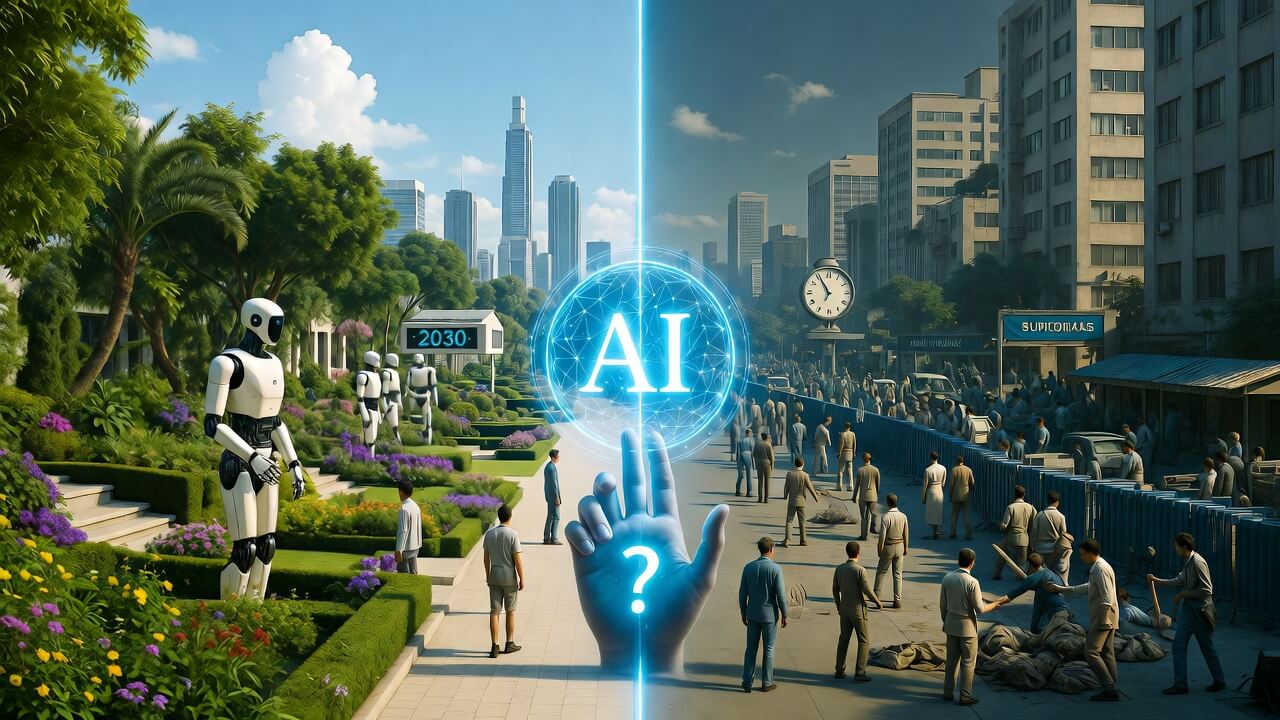
Introduction: Admiring Optimism While Seeking Realism
I follow @davidpattersonx on X, where David, a dedicated futurist, shares bold predictions about AI’s transformative impact by 2030—just a few short years away. His enthusiasm, blue-sky thinking, and unwavering optimism are infectious and inspiring.
That said, I believe his timelines are overly aggressive. This post stems from a question I’ve asked him twice (phrased slightly differently each time), without reply:
What happens if your 2030 projected timeline for the confluence of the effects of AI doesn’t materialise?
I share the excitement about AI’s potential, but we must temper it with realism. The post-scarcity utopia David envisions, a world of true abundance, will almost certainly arrive eventually, provided humanity avoids catastrophic setbacks. Yet it won’t materialise by 2030. In my view, we’ll begin glimpsing elements of this future around 2050, with a fuller realisation perhaps from 2200 onwards.
I remain profoundly optimistic about humanity’s long-term trajectory and the exponential gains AI will deliver. However, cautious optimism, grounded in reality, is essential.
Persistent Human and Societal Challenges
Technology alone cannot swiftly overcome deep-rooted problems that have plagued humanity for millennia. Issues such as:
- Poverty
- Hunger
- Homelessness
- War and conflict
- Cultural and religious differences
- Systemic racism
- Overwhelming greed
- Broken political systems
These are not mere technical glitches; they stem from human nature, entrenched societal structures, bureaucracy, and regulatory inertia. As Albert Einstein observed, “It has become appallingly obvious that our technology has exceeded our humanity.” Rapid technological leaps won’t erase these in under four years.
The Need for Profound Societal Reform
To reach a harmonious, advanced future; something akin to the optimistic vision in Star Trek, society must undergo fundamental change alongside technological progress. This requires a convergence of AI-driven advancements and deep shifts in societal psychology and structures.
Societal transformation typically spans multiple generations (potentially 50-100 years or more) for new norms to take root and endure. Without this parallel evolution, we risk dystopian outcomes like those in Elysium or Blade Runner, where technology amplifies inequality rather than resolving it.
Key elements that may need to be abandoned or radically reformed include:
- The monetary system and money as a primary motivator
- Religion in its publicly dominant forms
- Geographical borders
- Extreme selfish individualism
- Current political systems
This is controversial, but it’s difficult to imagine today’s billionaires voluntarily relinquishing wealth, status, and power overnight.
Critiquing David’s Key Predictions
Here are my grounded thoughts on David’s main talking points, with realistic timelines and caveats.
Mass Adoption and Dominance of Autonomous Cars/Robotaxis by 2030
Mass adoption depends on how one defines it. In developed regions, pockets of rapid progress are plausible, but global scale, including in developing countries, is improbable. As an example, many nations in Africa struggle with basic electricity generation and meeting everyday needs; widespread EV and robotaxi infrastructure faces immense hurdles. Regulatory bureaucracy and safety concerns could delay full dominance for decades, though some forward-leaning areas (e.g., certain US states) might accelerate locally.
All Human Jobs Fully Replaced by AI and Humanoid Robots by 2030
Digital and knowledge-based roles could see massive displacement. However, physical vocational trades; like plumbing, fishing in remote villages, or manual labour in low-infrastructure areas, remain far from replacement. Humanoid robots capable of reliable, dexterous real-world tasks won’t mature that quickly.
Achievement of AGI and ASI by End of 2026
AGI might, just possibly, emerge in the coming years, but ASI by late 2026 feels optimistic. Scaling compute yields diminishing returns; breakthroughs in algorithms and brain-like architectures are crucial. Approaches like China’s focus on efficient models (e.g., DeepSeek) highlight that raw power alone isn’t enough. As I noted in an earlier post: unlimited compute won’t deliver ASI without a paradigm shift akin to a “positronic brain.” see: my post from 2025
Transition to Post-Scarcity and Superabundance Economy
Possible in the longer term, but dependent on societal foundations shifting. The 1% super-wealthy will resist ceding dominance, slowing equitable distribution.
Universal Basic Income (UBI/UHI/UEI) as a Bridge
A sensible interim step in wealthier nations, but unfeasible globally. Debt-burdened developing economies with fiscal challenges can’t afford it, and tech benefits will take time to trickle down.
True Post-Scarcity with Effectively Free Goods, Services, and Housing
Eventually, yes, but not by 2030. A glimmer may appear by 2050, with fuller abundance from 2200.
One-Shot Cures for All Diseases and Comprehensive Biological Mastery
This is among the more plausible near-term advances, given rapid biotech progress. The real barrier will be equitable access; pharmaceutical interests may gatekeep or price-wall breakthroughs, limiting benefits to the majority.
Perfect Full-Immersion Virtual Reality Indistinguishable from Reality
Highly advanced VR is coming, but “perfect” and truly indistinguishable requires merging biology and technology (e.g., neural interfaces). Improvement, yes; flawless perfection by 2030, no.
Technology Reaching Its Optimal End-State and Limit
This assumes we’ve exhausted all possible knowledge. We’ve barely scratched the surface of the universe; new sciences could emerge, enabling breakthroughs like practical interstellar travel. Technology evolves; it doesn’t hit an absolute ceiling.
Broader Societal, Philosophical, and Lifestyle Shifts
These align with the generational reform needed. New societal psychology won’t embed overnight.
Contact with Extraterrestrials Shortly After 2030
Human history suggests intriguing possibilities of past contact, but concrete evidence remains elusive.
Conclusion: The Singularity Remains Elusive
The Singularity is not imminent and won’t arrive by 2030. When we can universally agree on its definition, we may well have already crossed it. In the meantime, let’s embrace AI’s promise while acknowledging human complexities. True abundance requires not just technological mastery, but wisdom and reform across generations.