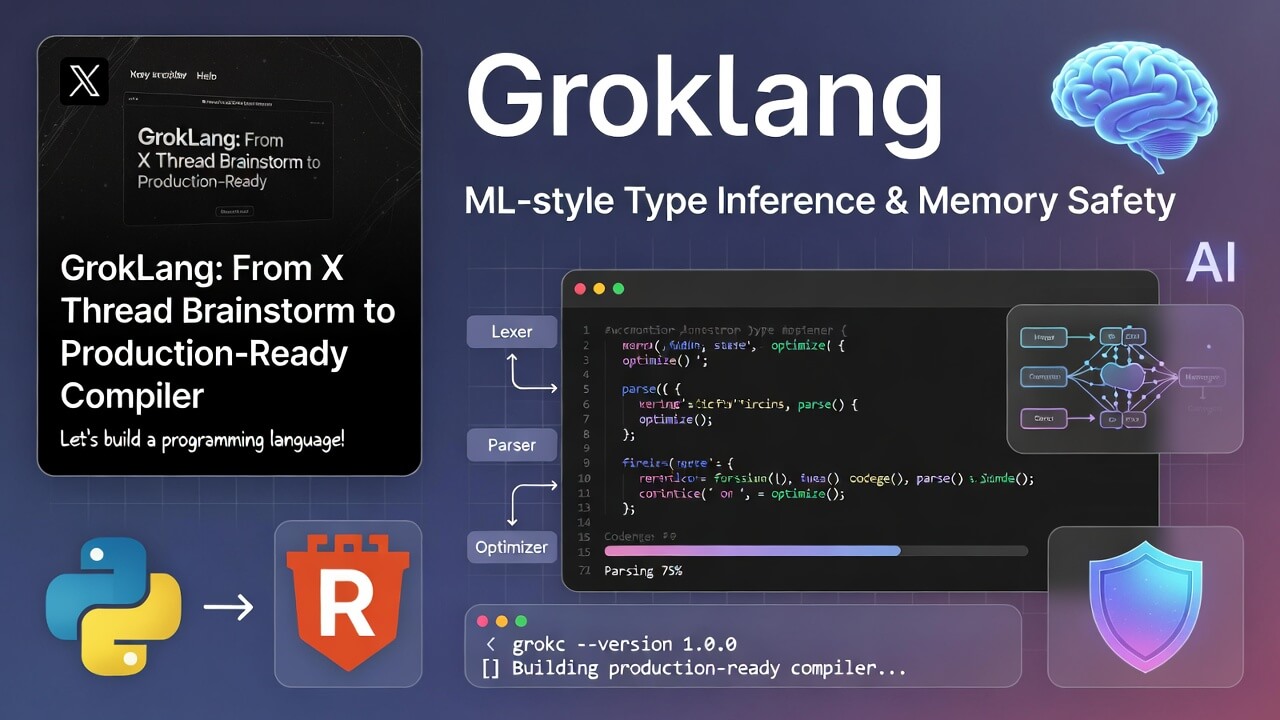
The Spark: A Casual Conversation on X
It all began with a seemingly innocuous question on X (formerly Twitter): “Which programming language would you recommend for someone who is new to web development?” The thread quickly evolved into something far more ambitious, a collaborative brainstorming session with Grok, xAI’s AI, to design an entirely new programming language. What started as a joke turned into a serious exploration of programming language design, covering core components like syntax, type systems, memory management, concurrency, and even AI integration.
The conversation wasn’t just idle chatter; it produced a minimal project draft that captured the essence of what would become Groklang. This draft outlined the language’s fundamental principles: ML-style type inference for expressiveness, Rust-inspired memory safety to prevent bugs, actor-based concurrency for scalability, and built-in AI decorators for intelligent code assistance. The repo, kabudu/groklang, stands as a testament to how a simple online discussion can birth something substantial.
Expanding the Vision: From Draft to Comprehensive Specification
The initial draft was promising but skeletal. To transform it into a viable project, I leveraged Claude Haiku 4.5 to expand the minimal outline into a detailed project bible. This bible included:
- Type System: Full Hindley-Milner type inference with traits and generics
- Memory Safety: Borrow checker algorithm with optional AI-managed garbage collection
- Concurrency Model: Threads, actors, and supervision trees with deadlock detection
- AI Integration: Compile-time and runtime decorators for optimization, testing, and translation
- FFI Capabilities: Bidirectional interoperability with Python, C, Rust, Go, and more
- Standard Library: Collections, I/O, threading, and synchronization primitives
- Grammar and Runtime: EBNF-based syntax, stack/heap allocation, and bytecode VM with JIT compilation
The specification wasn’t just theoretical. It included working code examples, validation checklists, and a 20-week implementation roadmap. This comprehensive package ensured that Groklang could be built by experienced compiler engineers with minimal guesswork.
Implementation Journey: Python Prototype to Rust Production
The actual coding began with a Python foundation, using PLY (Python Lex-Yacc) for the lexer and parser. This choice allowed rapid prototyping of the core components. The initial implementation featured:
- A recursive descent parser generating an AST
- Basic type checking with constraint generation and unification
- A stack-based VM for execution
- Simple AI service integration via HTTP calls to LLM APIs
However, performance benchmarks revealed the limitations. For a recursive Fibonacci calculation (fib(30)), the Python implementation clocked in at around 1.27 seconds. Roughly 20 times slower than native Python. This was unacceptable for a language positioning itself as a modern alternative.
The pivot to Rust was decisive. Rust’s ownership system, zero-cost abstractions, and native performance made it ideal for a systems-level language like Groklang. The Rust implementation introduced:
- Cranelift JIT Compiler: For dynamic native code generation, achieving up to 56x speedups in tight loops
- Optimised VM: Register-based execution with specialised opcodes (e.g.,
IntAdd,IntLt) and inline caching - Advanced Optimisations: Tail call optimisation, fast local variables (33x faster than HashMap lookups), and bytecode specialisation
The result? Dramatic performance improvements. The optimised Rust version executes fib(30) in 0.23 seconds. Only 3.6x slower than Python, a massive leap from the initial implementation.
Note: The implementation was assisted by Grok Code Fast 1 and Gemini Pro / Flash for coding and optimization tasks.
Core Components: Technical Deep Dive
GrokLang’s design draws from the best of modern language theory while incorporating novel AI features. Here’s a closer look at the key components:
Type System: ML-Style Inference with Rust-like Safety
GrokLang uses Hindley-Milner type inference, allowing code like:
fn map(f, list) {
    if list.is_empty() { [] } else { [f(list.head())] + map(f, list.tail()) }
}
The compiler infers f: (a) -> b and list: [a], returning [b]. This is combined with a borrow checker that prevents data races:
fn process(data: &mut Vec<i32>) {
    // Borrow checker ensures exclusive access
    data.push(42);
}
Concurrency: Actors and Supervision
Concurrency is built around the actor model with supervision:
actor Counter {
    state: i32,

    fn increment(self) {
        self.state = self.state + 1;
    }

    fn get(self) -> i32 {
        self.state
    }
}

fn main() {
    let counter = spawn(Counter { state: 0 });
    counter.increment();
    println(counter.get()); // 1
}
AI-powered deadlock detection monitors message passing and suggests fixes at compile time.
AI Integration: Decorators for Intelligent Development
GrokLang’s killer feature is built-in AI assistance:
#[ai_optimize(level: "high", target: "speed")]
fn expensive_calculation(data: &[i32]) -> i32 {
    data.iter().map(|x| x * x).sum()
}

#[ai_test(iterations: 100)]
fn my_function() {
    // AI generates comprehensive test cases
}

#[ai_translate(target_lang: "python")]
fn translate_me() {
    println("This becomes Python code");
}
These decorators integrate with providers like DeepSeek or OpenAI, caching results for performance.
FFI: Seamless Interoperability
GrokLang supports calling external functions:
extern fn printf(format: *const c_char, ...) -> i32;

fn main() {
    printf("Hello from GrokLang!\n");
}
This extends to Python, Go, and other languages, enabling gradual migration.
Benchmark Summary: Performance Achievements
The Rust implementation delivers impressive performance:
| Language/Mode | fib(30) Time | Relative to Python | Notes |
|---|---|---|---|
| Rust (native) | 0.0022s | ~28x faster | AOT compilation |
| Go (native) | 0.0030s | ~21x faster | AOT with GC |
| Python (CPython) | 0.0630s | 1.0x (baseline) | Interpreted |
| GrokLang (Optimised) | 0.2300s | ~3.6x slower | Specialised VM |
| GrokLang (Base) | 1.2732s | ~20x slower | Actor-based VM |
For iterative workloads, JIT compilation shines:
| Test Case | Python | GrokLang (Interpreter) | GrokLang (JIT) | Speedup |
|---|---|---|---|---|
| Iterative Sum (n=1M) | 26.10ms | 29.48ms | 0.46ms | ~56x |
These results demonstrate GrokLang’s ability to compete with established languages while offering unique AI features.
Conclusion: The Power of Open Source Collaboration
Building Groklang was a journey from a whimsical X thread to a fully-featured programming language with production-quality tooling. The combination of AI-assisted design, rigorous specification, and performance-focused implementation created something truly unique; a language that not only compiles and runs efficiently but actively helps developers write better code.
The project showcases how modern development can blend human creativity with AI capabilities, resulting in innovations that push the boundaries of what’s possible in programming language design.
It’s open source, you know what to do. Check out kabudu/groklang, star the repo, contribute features, or even build your own language inspired by this work. The next breakthrough might come from your fork.